
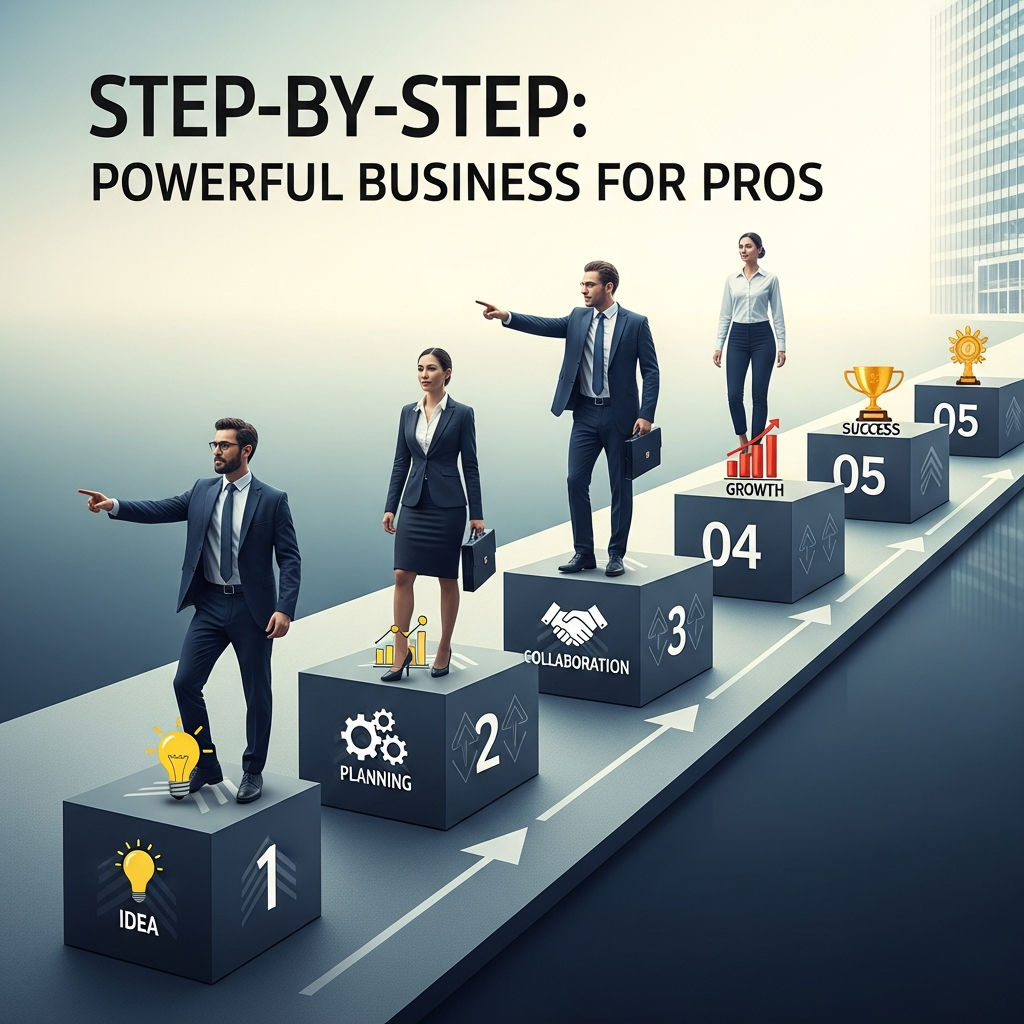
Step-by-Step: Building a Powerful Business for Pros
For established entrepreneurs, seasoned professionals, and business owners looking beyond mere survival, the quest for a truly powerful business is an ongoing journey of strategic refinement and relentless optimization. A “powerful business” isn’t just profitable; it’s resilient, scalable, impactful, and built on an enduring foundation that withstands market shifts and competitive pressures. This comprehensive guide outlines a step-by-step methodology to elevate your enterprise from successful to genuinely formidable, tailored for those who are ready to push the boundaries of their current achievements.
Phase 1: Strategic Foundation & Re-evaluation
Even the most experienced professionals benefit from periodically revisiting their core strategy. This phase is about looking inward and outward with fresh eyes, ensuring your fundamental vision is aligned with future ambitions.
Step 1: Deep Dive into Vision & Mission Refinement
- Revisit Core Purpose and Long-Term Goals: Beyond immediate objectives, what is the ultimate legacy you wish to create? How does your business contribute to a larger ecosystem or solve significant problems? Ensure your vision isn’t just aspirational but also actionable.
- Align with Personal Values: For many pros, their business is an extension of themselves. Reconfirm that the direction of your enterprise resonates deeply with your personal values and life goals. Discrepancies here can lead to burnout or misdirection.
- Evaluate Current Operations Against Vision: Conduct a brutal audit. Are current activities, product lines, and service offerings genuinely moving you towards your refined vision, or are there legacy elements holding you back?
Step 2: Advanced Market & Competitive Analysis
- Beyond SWOT: Comprehensive Environmental Scanning: Utilize frameworks like PESTEL (Political, Economic, Social, Technological, Environmental, Legal) and Porter’s Five Forces to gain a holistic understanding of the broader market landscape.
- Identify Emerging Trends & Niche Opportunities: Don’t just track existing competitors. Look for weak signals of emerging trends, technological shifts, and underserved niches that could be future growth engines or potential disruptors to your current model.
- Strategic Competitor Analysis: Analyze competitors not just on products/services, but on their operational efficiencies, talent acquisition, strategic partnerships, and customer engagement models. What can you learn, adapt, or strategically counter?
Step 3: Core Competency & Unique Value Proposition (UVP) Optimization
- Pinpoint True Differentiators: What are your organization’s inimitable strengths? These aren’t just what you do well, but what you do uniquely well that is difficult for others to replicate.
- Strengthen Existing Advantages: How can you further invest in and amplify these core competencies? Can you patent, trademark, or culturally embed them to make them even more defensible?
- Craft a High-Value UVP: Refine your Unique Value Proposition to clearly articulate the distinct benefits and superior value you offer, specifically targeting high-value clients and market segments who appreciate and are willing to pay for your unique strengths.
Phase 2: Operational Excellence & Scalability
A powerful business runs like a well-oiled machine, capable of consistent performance and poised for growth without compromising quality or increasing chaos.

Step 4: Streamlining Systems & Processes for Efficiency
- Automation Opportunities: Identify repetitive tasks across all departments (marketing, sales, operations, finance) that can be automated to free up human capital for higher-value activities.
- Lean Methodologies: Implement Lean principles to identify and eliminate waste (time, resources, effort) in all processes, improving flow and reducing lead times.
- Standard Operating Procedures (SOPs): Document and refine SOPs for critical functions. This ensures consistency, facilitates easier delegation, and reduces reliance on single individuals, crucial for scalability.
- Tech Stack Optimization: Audit your current software and tools. Are they integrated effectively? Are there gaps? Invest in technologies that provide real-time data, improve collaboration, and support future growth.
Step 5: Building a High-Performance Team & Culture
- Strategic Hiring & Talent Development: Recruit not just for current needs, but for future strategic goals. Invest in continuous learning, professional development, and cross-training to build a versatile and resilient team.
- Empowerment, Delegation & Accountability: Cultivate a culture of ownership. Empower team members with decision-making authority, delegate strategically, and establish clear accountability metrics.
- Leadership Development: Focus on developing leaders at all levels. A powerful business has a strong leadership pipeline, not just a single visionary at the top.
- Fostering Innovation & Continuous Improvement: Create a psychological safe environment where ideas are encouraged, failures are learned from, and continuous improvement is embedded in daily operations.
Step 6: Robust Financial Management & Growth Hacking
- Advanced Financial Modeling & Forecasting: Move beyond basic budgeting. Develop sophisticated financial models that allow for scenario planning, long-range forecasting, and impact analysis of strategic decisions.
- Profitability Analysis: Conduct deep dives into profitability by product, service, client segment, and even project. Identify areas of high and low profitability to make informed strategic adjustments.
- Strategic Investment Decisions: Allocate capital wisely. Evaluate potential investments in R&D, new markets, or acquisitions based on their long-term strategic fit and expected ROI, not just immediate gains.
- Funding Strategies for Scaling: If growth requires external capital, understand the various funding options (debt, equity, grants) and strategically position your business for attractive investment.
Phase 3: Market Domination & Sustainable Growth
With a solid foundation and optimized operations, the focus shifts to expanding influence, securing market position, and ensuring long-term vitality.
Step 7: Advanced Marketing & Sales Strategies
- Data-Driven Marketing: Leverage advanced analytics, AI, and machine learning to understand customer behavior deeply, personalize marketing efforts, and optimize conversion funnels across all channels.
- Multi-Channel Integration: Ensure a seamless, consistent brand experience across all touchpoints – digital, physical, and human interactions.
- Building Thought Leadership & Authority: Position your business and its leaders as authoritative voices in your industry through content creation, public speaking, and strategic PR. This builds trust and attracts high-value clients.
- Optimizing Sales for High-Ticket Clients: Refine your sales processes to focus on consultative selling, relationship building, and demonstrating complex value for clients with significant needs and budgets. Prioritize Customer Lifetime Value (CLV).
Step 8: Innovation, Diversification & Future-Proofing
- Continuous Product/Service Development: Establish a robust R&D pipeline. Consistently innovate and iterate on your offerings to stay ahead of customer needs and competitive threats.
- Exploring New Markets & Segments: Identify adjacent markets, new geographic regions, or previously underserved customer segments where your unique value proposition can resonate.
- Strategic Partnerships & Alliances: Forge mutually beneficial relationships with other businesses, suppliers, or even competitors to extend your reach, enhance your offerings, or access new capabilities.
- Risk Management & Contingency Planning: Proactively identify potential risks (economic, operational, reputational, technological) and develop comprehensive contingency plans to mitigate their impact.
Step 9: Measuring, Adapting & Iterating for Continuous Power
- Key Performance Indicators (KPIs) Beyond Vanity Metrics: Define and track KPIs that truly reflect business health, strategic progress, and customer value, moving beyond superficial metrics.
- Regular Strategic Reviews: Implement a cadence for reviewing your overall strategy, performance against KPIs, and market conditions. This isn’t a one-off exercise.
- Agile Business Development: Embrace an agile mindset. Be prepared to pivot, iterate, and adapt quickly based on market feedback, performance data, and emerging opportunities.
- Embracing Change & Disruption: A powerful business doesn’t fear disruption; it anticipates it and turns it into an opportunity. Foster an organizational culture that is comfortable with change and driven by continuous improvement.
Conclusion: The Ongoing Journey of Empowerment
Building a powerful business is not a finite destination but an ongoing commitment to excellence, foresight, and adaptability. For pros who have already achieved success, these steps provide a framework for not just maintaining momentum but accelerating growth, deepening impact, and securing a legacy. By meticulously executing each phase—from strategic re-evaluation and operational mastery to market leadership and perpetual innovation—you will forge an enterprise that is not only robust and profitable but truly powerful, capable of shaping its own future and dominating its chosen domain.