
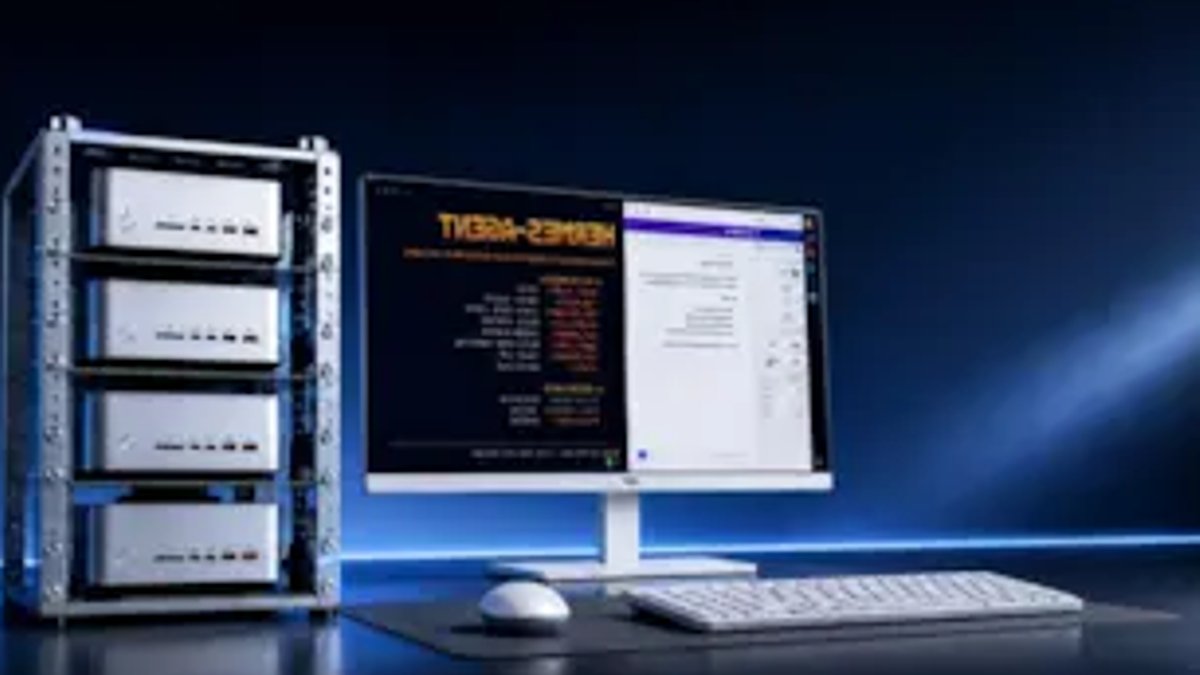
Companies are rushing to adopt AI, but running massive workloads on public cloud systems often comes with a price tag that makes finance departments wince. There is also the persistent issue of keeping sensitive corporate data within the firewall. Geekom, a Chinese manufacturer known for its compact hardware, has proposed a different path with a modular cluster built from four of its A9 Mega mini PCs. The goal is straightforward: deliver local compute power that rivals expensive server racks without the overhead.
Hardware Designed for Local Inference
Each A9 Mega unit houses an AMD Ryzen AI Max+ 395 processor. This chip integrates 16 Zen 5 cores and a Radeon 8060S graphics processor. When linked together, the cluster can reach a total computing power of 126 teraflops. The physical setup avoids the complexity of traditional data center equipment.
The units connect via USB4 cables, which removes the need for high-performance switches or dedicated server racks.
Read Also: Bbva offers 4 percent interest and cashback
The software stack is just as important as the silicon. Geekom relies on an architecture built on Ubuntu, ROCm, and DwarfStar. This combination distributes an optimized version of the DeepSeek V4 Flash model across the machines. An API compatible with OpenAI standards allows existing applications and AI agents to connect seamlessly. It’s a practical approach that doesn’t require rewriting entire development pipelines to get started.
For many mid-sized firms, the ability to keep prompts, source code, and credentials on internal infrastructure is the real selling point. Cloud solutions offer convenience, but they introduce a layer of risk regarding data sovereignty and ongoing operational costs. By keeping the workload local, companies retain full control over their data lifecycle. This setup allows IT teams to manage sensitive information without sending it to third-party servers.
Performance Metrics and Scalability
The cluster is designed to handle complex prompts with consistent speed. In tests involving 32 and 128 tokens, the system processed 14.61 tokens per second. The P95 latency for the first token was approximately 0.42 seconds.
Read Also: Certificates Offer Protection and Upside Leverage
These figures suggest the hardware can support real-time interactions for business workflows. The system also handles source code analysis and searches across multiple data sources.
Scalability is a core feature of the design. Businesses can begin with a single A9 Mega unit and expand the cluster by adding up to three more machines as demand grows. This modular approach lets organizations match their hardware investment to their actual usage patterns. It avoids the common pitfall of over-provisioning resources that sit idle most of the time. The workflow automation capabilities further extend the utility of the cluster beyond simple text generation.
Geekom has positioned this solution as a bridge between consumer-grade mini PCs and enterprise server infrastructure. The company emphasizes that the architecture supports high-performance tasks while maintaining a small physical footprint. For teams looking to experiment with local AI agents, this cluster offers a tangible starting point. The hardware is ready for deployment, and the software stack is configured to handle distributed model inference out of the box. It’s a pragmatic response to the rising costs and privacy concerns associated with cloud-based AI adoption.


Leave a Reply