
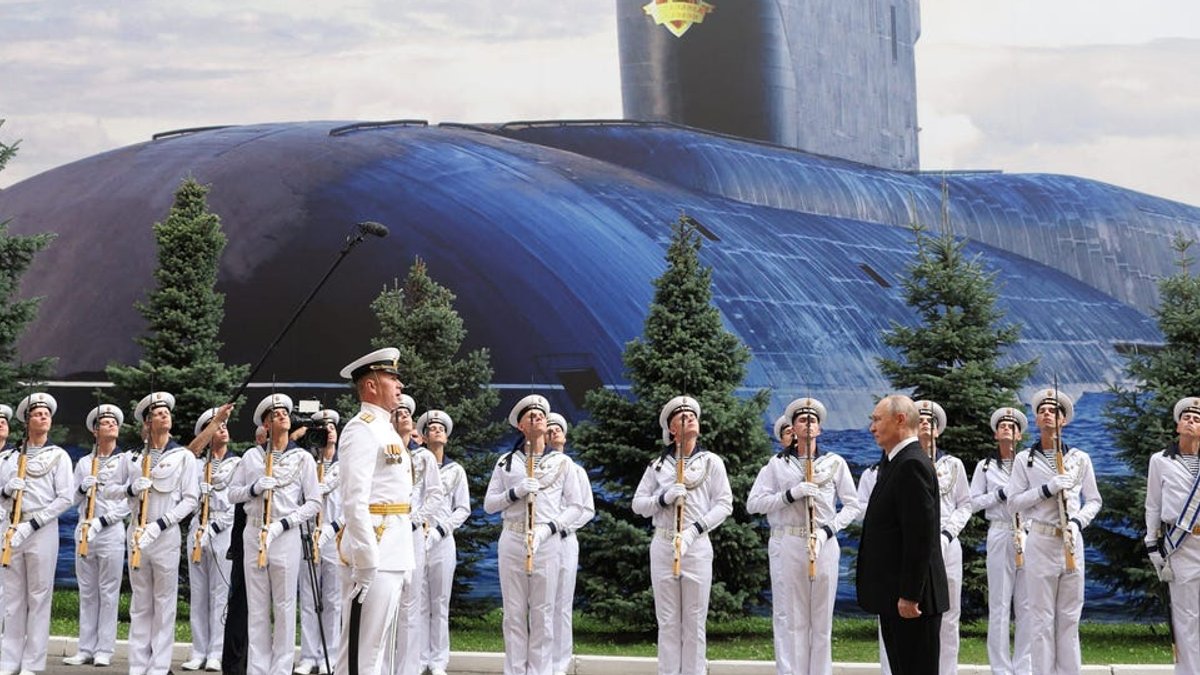
Russia marked Navy Day this year with a restrained ceremony, swapping its customary warship parade for large posters of submarines and surface vessels. The event, held at the Admiralty headquarters in St. Petersburg on Sunday, commemorated the 330th anniversary of the Russian Navy. President Vladimir Putin attended, meeting with commanders and presenting awards to personnel.
A modest display replaced the usual spectacle. Two rows of about 30 sailors stood in a cordoned-off courtyard, accompanied by a small military band. A towering poster of the Alexander Nevsky, a Borei-class nuclear-powered missile submarine, served as the focal point. Another poster showed two large combat surface vessels, a stark contrast to past parades that featured dozens of ships and thousands of sailors.
Related: Amazon scales back in house AI models
The Kremlin attributed the scaled-back event to “security reasons” and the “general atmosphere,” according to spokesperson Dmitry Peskov. Last year’s celebration had already been reduced, with only 2,500 personnel and around 20 vessels, down from over 40 warships, four submarines, and 3,000 personnel in 2023. Foreign dignitaries, once regular attendees, were absent this time.
Ukrainian drone strikes have repeatedly targeted Russian military and energy sites, prompting adjustments. St. Petersburg, roughly 600 miles from the Ukrainian border, has faced frequent attacks. Ukrainian forces conducted over 2,350 long-range strike missions in June, a tenfold rise since January. The strikes have disrupted oil terminals and major economic gatherings, including the St. Petersburg International Economic Forum.
Russia has strengthened air defenses around Moscow, installing multiple rings of S-500 and S-400 surface-to-air missile systems and dozens of Pantsir units on rooftops. Similar measures have affected other high-profile events, such as Victory Day parades, where drones caused airport closures and communication outages.
Related: Commodity Boom is Just Getting Started
Military displays have seen changes before. The annual Victory Day parade, a key national event, has also faced security-driven adjustments. Replacing warships with posters, however, represents a more symbolic step back from the Kremlin’s usual emphasis on military power.
Putin’s arrival at the Admiralty drew little attention beyond the small band and sailors. The posters of submarines and surface vessels now serve as temporary stand-ins. They reflect a naval tradition that, for this year at least, remains beyond reach.


Leave a Reply